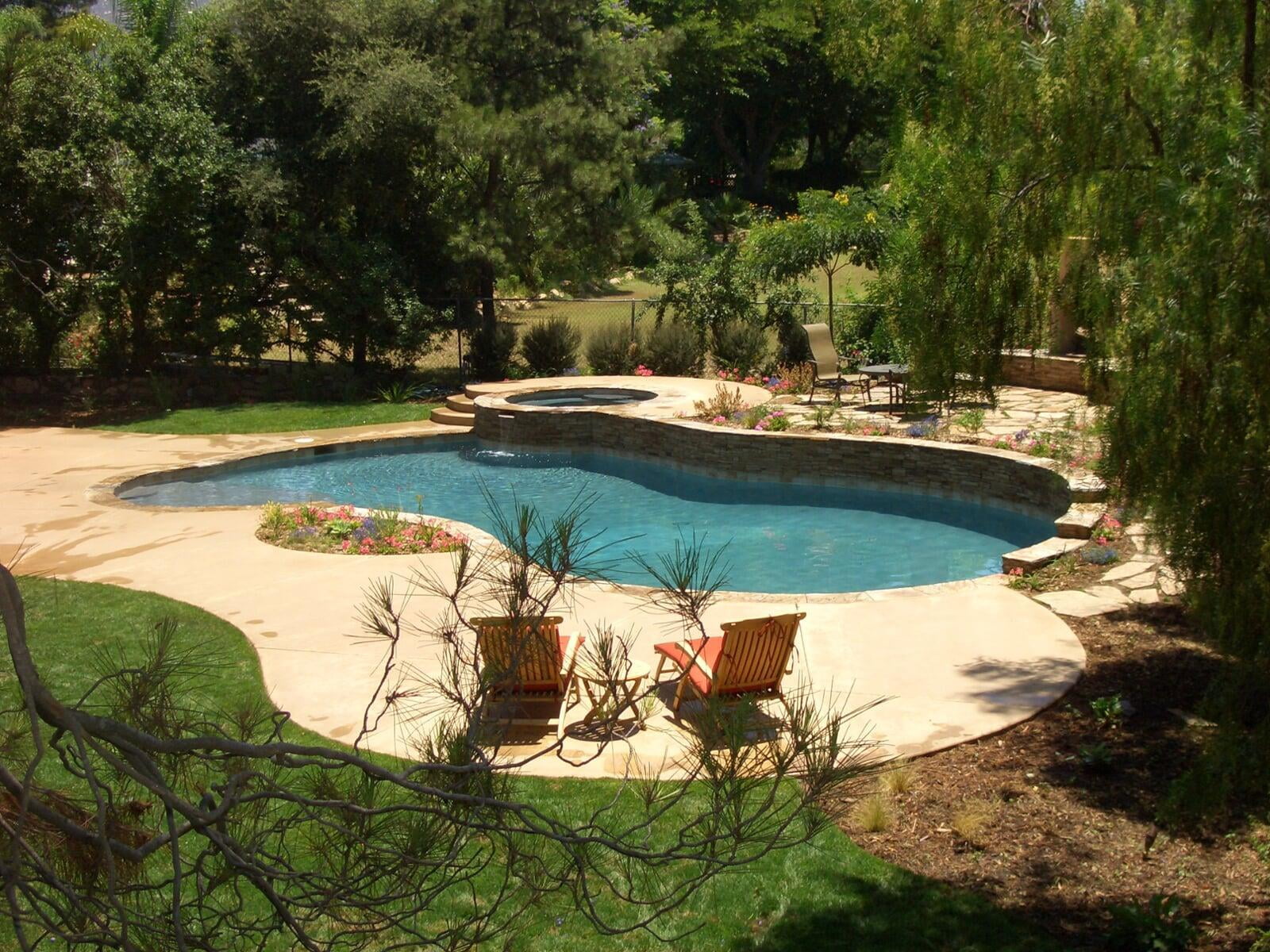
A hillside lot is where most contractors quote high, then walk. The view is the reason you bought it. The slope is the reason the bid keeps changing. Building on a slope is not landscaping with a grade. It is a structural job that has to carry everything above it, and if the structure under the ground is wrong, nothing you put on top of it survives.
San Diego County is hills. Canyon edges, graded pads, decomposed-granite ridges, and clay benches above the coast. We have built on slopes since 1984, and the pattern is always the same: the cut, the fill, the walls, and the water have to be solved first. Get those four right and the pool, the patio, and the view last for decades. Get them wrong and you are looking at a leaning wall, a cracked deck, or soil on your neighbor's lot. Here is how a hillside build actually works, in the order it has to happen.
Grading: cut, fill, and compaction
Every slope build starts by reshaping the ground into a usable, stable form. There are three moves.
Cut and fill
Cutting removes soil from the high side. Filling places it on the low side to extend a pad. The goal is balance, moving as little soil off-site as possible, because export costs money and trucks. The catch is that cut ground and fill ground behave differently. Cut sits on native, undisturbed soil. Fill is only as good as how it was placed.
Compaction
Fill that is not compacted in lifts settles. When it settles, whatever sits on it, a slab, a pool deck, a wall footing, moves with it. We place engineered fill in eight-inch lifts, compact each one to a tested density, and have it verified before the next lift goes down. That test record is what stands behind the work years later.
Benching
You cannot just dump fill on a slope and expect it to bond to the hillside. It will slide along the old surface. Benching cuts level steps into the existing slope so the new fill keys into native ground. It is the difference between fill that becomes part of the hill and fill that becomes a landslide.
Retaining walls: which one, and when you need an engineer
A retaining wall holds back the cut so your usable area stays flat. The type depends on height, soil, and load. Picking the wrong one is the single most common hillside failure we get called to repair.
- Gravity walls hold soil with their own mass, stacked stone, large block, or a thick concrete shape. They work for low walls on stable ground, roughly under three feet, with nothing pushing on them from above.
- Segmental block walls use interlocking units, often with geogrid layers tied back into the soil behind them. They handle moderate heights and tolerate minor movement. A good choice on many San Diego slopes when the height and surcharge are within the system's limits.
- Poured and cantilever walls are reinforced concrete on an engineered footing. They carry the tallest loads and the heaviest surcharges, a driveway, a pool, a structure above. This is what taller hillside cuts call for.
Here is the line. In San Diego County, a wall over four feet measured from the bottom of the footing, or any wall holding a surcharge regardless of height, generally needs an engineered design and a permit. A surcharge means something is pushing on the soil behind the wall: a slope continuing up, a driveway, a pool, a building. If your wall holds back a hillside or carries a load, you need a structural or geotechnical engineer, full stop. A wall sized off a catalog instead of the soil is a wall on a clock.
People think the wall is the expensive part. The wall is the easy part. The drainage behind the wall and the footing under it are where the wall lives or dies. We build the part you can't see to outlast the part you can.
Drainage: where the water goes
Water is what breaks hillsides. It builds pressure behind walls, saturates fill, and turns clay into something that moves. A slope build needs water handled at three levels, and all three have to reach a real outlet.
Behind the wall
Every retaining wall holding more than a low planter needs a drainage system behind its face: a column of free-draining gravel and a perforated pipe at the base that carries water to daylight. Without it, water collects behind the wall and adds hydrostatic pressure the wall was never designed to hold. That is why walls bow and weep.
Surface swales
Above and across the slope, graded swales catch runoff before it sheets down the face and feed it to a controlled path. They keep the surface water from ever loading the soil or the walls.
Subsurface and a real outlet
Subdrains handle the water already in the ground. And every part of the system has to discharge somewhere lower and legal, a street, a storm drain, a daylight outlet. A drain that connects to nothing just relocates the problem a few feet downhill, often onto the neighbor.
The soil reality: clay and decomposed granite
You cannot design a slope until you know what it is made of. San Diego gives you two common problems.
Inland and across much of the county, the soil is expansive clay. It swells when wet and shrinks when dry, and that movement is what cracks slabs, tilts walls, and shifts pool shells. Clay also holds water, so drainage matters more, not less. Closer to the coast and across the foothills you get decomposed granite, which drains well but ravels and erodes on a steep face and can carry surprising amounts of groundwater after a wet winter.
On any real hillside build, this is not a guess. A geotechnical report tells you the soil type, the bearing capacity, the groundwater, and the expansion index. Those numbers drive the footing depth, the fill spec, the wall design, and the drainage. Skipping the soils report on a slope is how a project goes wrong before the first cut.
Sub-base, pool shells, and hydrostatic pressure
Anything you build on the graded ground needs a sub-base matched to the soil. Hardscape on a slope, a patio, a driveway, a deck, sits on a compacted aggregate base over prepared subgrade, with its own fall built in so water never ponds and never soaks the soil holding the slope.
A pool on a slope is its own structural problem. The shell has to bear on sound native ground or properly compacted engineered fill, and the downhill side usually needs a retaining wall or grade beam to hold the cut. Then there is the water. A pool set into a slope sees groundwater pushing on it from behind and below, hydrostatic pressure that can crack a shell or, on an empty pool, lift it out of the ground. The design answers that with subdrains around the shell and a hydrostatic relief valve in the floor. None of that shows in the finished pool. All of it is why the finished pool is still there in twenty years.
Permits and engineered plans
Hillside work in San Diego County is permitted work. Grading past a threshold volume, retaining walls over four feet or carrying a surcharge, and pools all pull permits, and most pull engineered plans. That is not red tape to route around. The engineered plan is the proof that the wall, the fill, and the drainage were designed for your actual soil and your actual loads. It is also what protects you when you sell, and what stands behind the structure if anything is ever questioned. We build to the plan and to code, every time, under the same clean ten-year structural liability we have carried since 1984.
What a hillside build actually sequences
The reason hillside projects fail is almost always order. People want to see the view deck and the pool, so the structure gets rushed or value-engineered out. We build it in the only order that lasts:
- Soils report and engineered plans
- Cut, fill, benching, and compaction, tested
- Retaining walls on proper footings
- Drainage behind the walls, swales above, subdrains, and a real outlet
- Sub-base and pool shell with hydrostatic relief
- Then, and only then, the hardscape, the planting, the view you bought the lot for
Because we run one team and no subcontractors, the crew that compacts the fill is the crew that sets the wall and the crew that pours the deck. Nobody hands off the part that fails to someone who blames the last guy. The structure is right because the same people own it from the first cut to the last finish.