Low-water planting that actually holds.
Drought-tolerant planting and smart drip irrigation designed around how you use the yard — usable low-water space, lower bills, and a palette that fits your sun and soil instead of fighting it. San Diego County, since 1984.
Request a Property Assessment →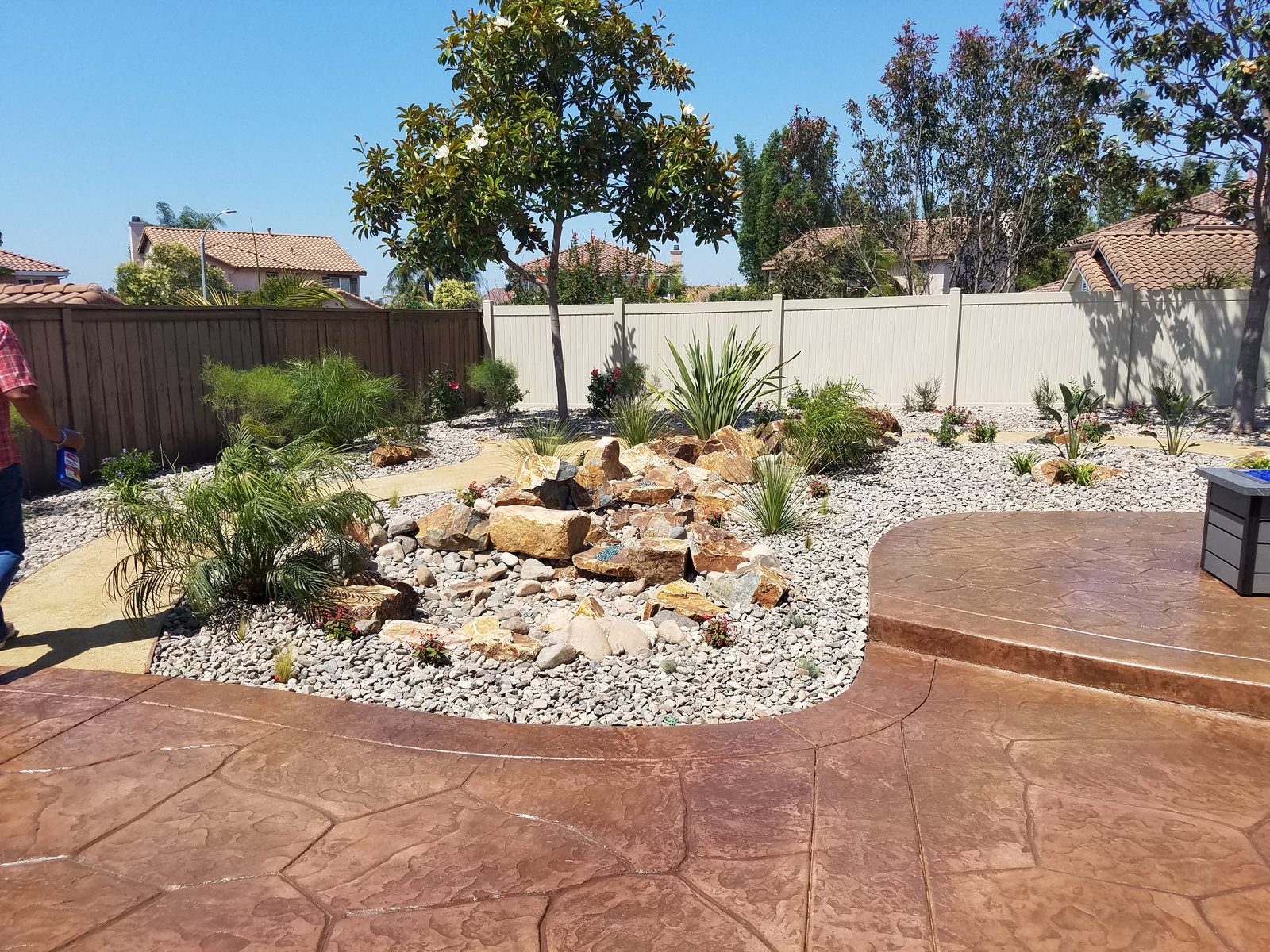
A low-water yard you actually use.
Pulling out a thirsty lawn is not about giving something up. Done right, a drought-tolerant yard is more usable, not less: decomposed-granite paths you can walk, planting that gives you color and screening where you want privacy, open space that holds up to kids and dogs, and a water bill that drops by half or more. We start by working out how you live in the yard — where you sit, where you walk, what you want to look at — and design the planting and the hard surfaces around that.
Plant choice follows the same logic. We pick a palette that fits your sun, your soil, and how much attention you actually want to give it, mixing California natives for the parts you want to leave alone with broader drought-tolerant selections where you want a specific look. The point is a yard that thrives on its own terms, not a catalog spread that struggles the first dry summer.
The irrigation is built to match. We zone the drip by sun and plant type, run it to the root instead of spraying the air, and put it on a smart controller that waters by weather rather than a fixed clock. That is where the savings come from, and it is what keeps the planting healthy with almost none of your time. We have built low-water yards this way since 1984.
What’s included.
- A low-water layout designed around how you use the yard — paths, gathering, open space, screening
- Drought-tolerant and California native planting selected for your sun, soil, and how much upkeep you want
- Decomposed granite paths, dry-creek beds, and boulder features that replace thirsty turf
- Smart, weather-based controllers zoned by sun and plant type so every area gets what it needs
- Pressure-compensating drip irrigation run to the root, mapped to the planting plan
- Mulch and ground cover to hold moisture, cut evaporation, and suppress weeds
- Guidance on current water-district rebates so the conversion qualifies where one applies
- Soil prep and site work so the planting takes hold and the yard lasts
Our process.
How you use it
We walk the property, work out how you want to live in the yard, and check your sun and soil. We talk through where you want planting, paths, and open space, and check what rebates your water district has on offer — before a number is priced.
Plan & zoning
You see the planting plan and the irrigation layout together. Plant palette, decomposed granite and dry-creek features, and the drip zones get drawn around how you want to use the space, with the site work the lot requires.
Built in-house
Site prep first so the planting takes hold. Then soil amendment, drip lines mapped to the plan, planting, decomposed granite, and mulch. Every phase runs in-house, one crew accountable for the one before it.
Program & warranty
We program the smart controller to the planting plan, walk you through running it by zone, and hand it off. Then the work is ours to stand behind.
Why bring us your yard.
Forty years, same owner
Darren Earl has been planting and irrigating San Diego County properties since 1984. He has watched what thrives on this region’s soil through four decades of drought cycles and rebate programs. The owner prices the job himself, and his in-house crew, not a rotating cast of subs, builds it.
One team, no subcontractors
Most low-water installs hand the design to one crew, the drip to another, and the planting to a third, each blaming the last when a zone runs dry. We run every phase in-house. One contract, one number to call, no gaps between trades for a problem to hide in.
Designed for how you live
A low-water yard only works if it fits how you actually use the space and how much upkeep you want. We design the planting and the watering around that, then back the work with a clean record across forty years — zero structural complaints. The savings show up on the bill, the yard stays usable, and it holds.
Xeriscape questions, answered straight.
Tell us about the yard.
Bring us the lot — a lawn you’re ready to lose, a slope you’re tired of fighting, or a blank yard. We come look at it, work out how you want to use it, and give you a fixed-price concept for the planting and the irrigation together. No charge for the visit.
Saturday · By appointment
Sunday · Closed
We’ll be in touch within one business day to schedule the visit.