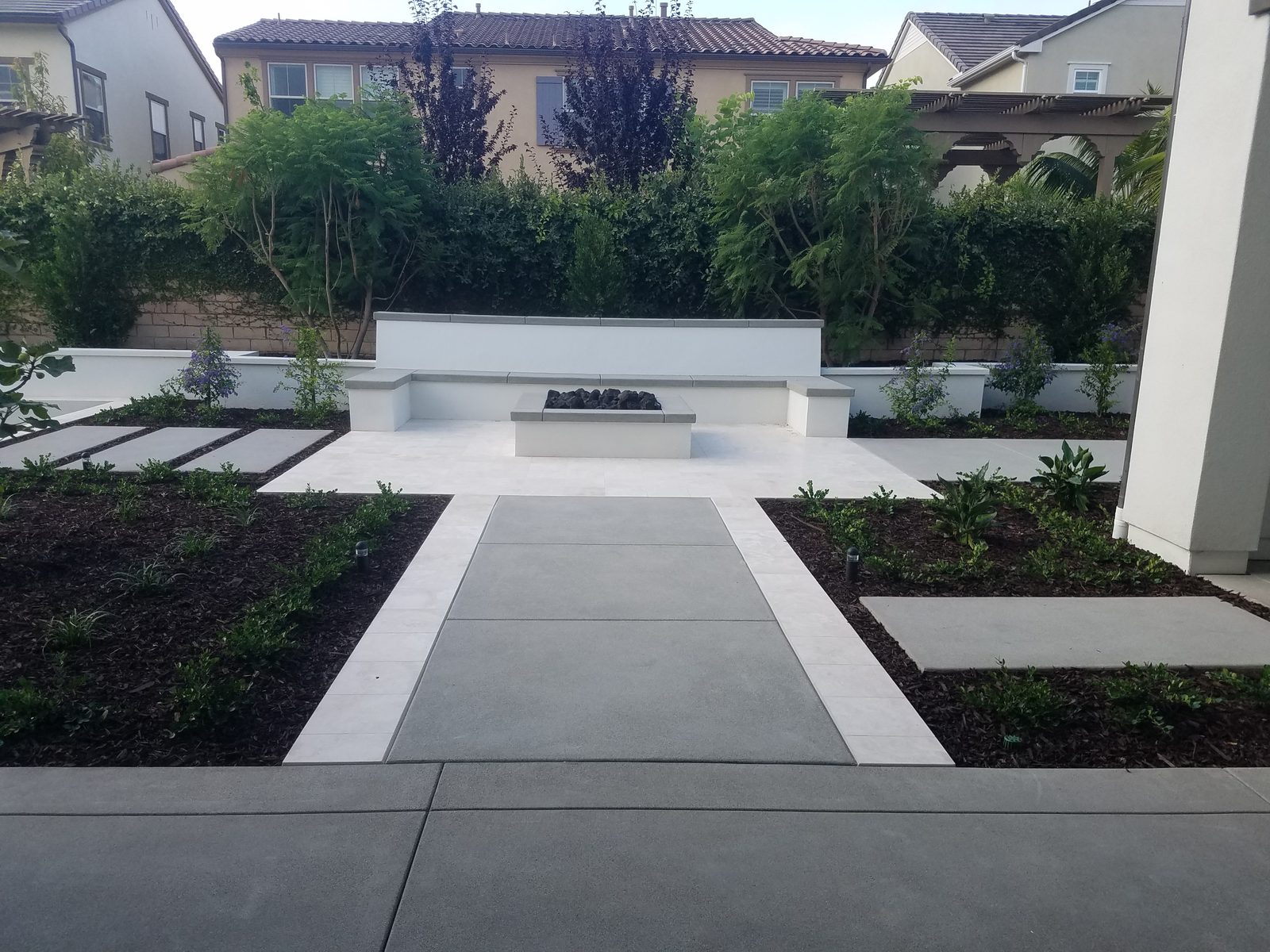
People ask us which surface is best: concrete, pavers, or natural stone. The honest answer is that none of them is best in the abstract. The right one depends on how you’ll use the space, what you want it to look like, and what you want to spend, both now and over the next ten years. The material is the decision, and it is worth making with real information instead of a showroom sample.
The three surfaces are genuinely different. They cost different amounts, they wear differently, they ask for different maintenance, and they fail in different ways when they do fail. Here is how each one performs on the things that actually decide whether you are happy a decade from now.
The three materials, side by side
Here is the short version. The rest of the article explains the why.
| Poured concrete | Pavers | Natural stone | |
|---|---|---|---|
| Install cost | Lowest | Middle | Highest |
| Over time | Rigid, can show a crack | Flexible, individual units | Hardest material, set by hand |
| San Diego sun | Can fade and stain | Color-stable, replaceable | Holds up; some stones heat up |
| Maintenance | Low day to day | Joint sand, weeds, top-ups | Periodic sealing |
| Repair | Patch or replace a section | Lift and swap one unit | Re-set or replace a piece |
Cost: what you pay, and when
Poured concrete is the cheapest to install. Fewer materials, faster labor, one pour. Pavers run higher because every unit is set by hand and the base prep is more involved. Natural stone is the most expensive, both for the stone and for the skill it takes to set irregular pieces level.
But install cost is half the number. The other half is what you spend over the next decade. A concrete slab that cracks across the middle is a section to patch or tear out. A paver field repairs one unit at a time for the price of one paver. Run the cost over ten years, not over the first invoice.
Durability: how each one holds up
San Diego is easy on hardscape in some ways and hard in others. The climate is mild, but much of the inland county sits on expansive clay that moves a little with the seasons, and that movement tests a rigid surface more than a flexible one. This is where the three materials separate.
Poured concrete
A slab is one rigid piece. It is strong and it is cheap, but it has no give. Over years of seasonal movement it can show a crack, and good control joints decide where that crack lands rather than whether it happens. For many yards that is a fine trade for the price. Just go in knowing concrete is the least forgiving of the three.
Pavers
A paver field is hundreds of small units with sand joints between them. That makes it the most flexible surface of the three: it gives a little instead of snapping, so it rarely shows the long crack a slab can. It is the most forgiving choice for a yard that sees heavy use or seasonal movement, which is why we steer a lot of clients toward it.
Natural stone
The stone itself is the hardest and most durable material of the three, and it shrugs off the sun. Set in mortar it behaves more like a slab; set as a flexible field on a sand bed it behaves more like pavers. It is the most demanding to install well, and the most rewarding to look at, which is exactly the trade you are buying.
The sun is the easier test. All three handle San Diego heat well. Concrete can fade and stain over the years. Pavers hold color and a faded one swaps out. Stone is stable, though darker stones in full sun get hot underfoot, which matters around a pool.
The material is the decision, and it’s the one people make too fast. Concrete, paver, or stone, each one is right for a different yard and a different budget. My job is to match the material to how you’ll actually use the space, not to sell you the most expensive sample on the table.
Maintenance: the honest version
No surface is zero-maintenance. Here is what each one actually asks of you.
- Concrete is the lowest day to day. Hose it off. Reseal it every few years if you want to hold off stains. The work comes all at once when it cracks.
- Pavers need joint sand topped up over time, weeds pulled from the joints, and an occasional re-set of a unit that has settled. Polymeric joint sand cuts the weeds down hard. The trade for that upkeep is the easy repair.
- Natural stone usually wants periodic sealing, more often for porous stones, less for dense ones. Sealed stone resists stains from oil, leaves, and pool chemicals.
Repairability: how each one fails
This is the part most comparisons skip, and it is the one you live with. Concrete fails as a unit. A crack or a heaved section means cutting out and re-pouring, and the patch rarely matches. Pavers fail one piece at a time. Lift the bad unit, fix the base under it, drop a new one in. Natural stone is in between: a cracked piece is replaceable, but matching the original stone and re-setting it level takes a hand that knows stone. If you value being able to fix a small problem cheaply, pavers win that fight outright.
Matching the material to your budget
Here is the part that should change how you shop. The three materials don’t just cost different amounts to install, they cost different amounts to own. Concrete is the lowest entry price and the cheapest to maintain day to day, with the catch that a future crack repair is all-or-nothing. Pavers cost more up front and ask for a little ongoing care, and in return any single unit is cheap to swap. Stone is the highest price in both columns and buys you a look the other two can’t touch.
So the smart move is to spend where you’ll feel it. A big back patio you live on every day may be worth pavers for the easy repairs. A side yard nobody sees can be concrete. A small entry walkway is the place to put the stone you love, because the square footage keeps the total in check. We’ll show you where the upgrade earns its keep and where it just adds a number, so the budget lands on the part of the yard that matters most to you.
Which should you choose, by use
The right answer depends on where it goes.
- Driveway. Heavy, repeated loads. Pavers handle the weight and let you repair a sunken spot without re-pouring the whole drive. Concrete works if the base and joints are right and you accept eventual crack repair.
- Patio. Pavers for most clay-soil yards, because they flex and repair easily. Stone if you want a specific look and the budget for it. Concrete if cost is the deciding factor and you understand it will crack somewhere.
- Pool deck. Pavers or a cooler-toned stone. The surface stays cooler underfoot than dark stone or plain gray concrete, and a wet paver deck is less slick than smooth slab.
- Walkway. Any of the three. Light loads, small area. This is the place to spend on natural stone if you want it, since the square footage keeps the cost in check.
How we help you choose
We start with how you’ll use the space: where people walk, where they gather, how much traffic the surface takes, and how you want it to look. That points to the material before anyone opens a price book. Then we lay out the real numbers, install and ten-year ownership, so you can put the budget where you’ll feel it. We’ll take design control when a layout won’t function, and we’ll tell you straight when a cheaper material is the right call. One team builds the whole thing, no subcontractors handing off the part that matters, under the same ten-year structural liability we’ve carried, clean, since 1984.